The Social Subsystem
What is this?
The Social Subsystem describes how people in a Smartup organize, collaborate, and make decisions together. It replaces hierarchical management and fragmented teams with a decentralized system of shared ownership, trust-based roles, and mutual accountability. This subsystem creates the social architecture needed to build technology in a way that's fair, resilient, and aligned with the public good.
Just give me the abstract
The Social Subsystem redesigns how people work together by introducing democratic governance, peer support structures, and fluid identity protocols. Instead of traditional management, Smartups rely on a balance between autonomy, discipline, and mission-alignment—enforced not by authority, but by structure. Contributors operate in role-based groups, make collective decisions using the ADM Triangle, and support each other through systems like the Buddy Program. This model aims to unlock large-scale collaboration by treating contributors as citizens—not employees—in a shared mission to build public-interest technology.
The Architecture of a Smartup
Definition:
A Smartup creates trustworthy digital tools that help people—and the communities they form—become more resilient, resourceful, and effective in advancing the SDGs.
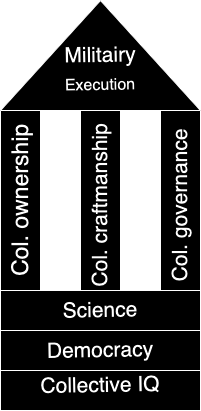
At its core, every Smartup is built like a rocket: a solid foundation, three structural pillars, and a sharp point of execution.
The Foundation (Our Fuel)
- Science: Every tool we create is grounded in facts, evidence, and tested knowledge. The problems we tackle are science-proven, and solutions must stand up to real-world scrutiny.
- Democracy: Our process and decisions are open and participatory. Everyone has a voice and a vote—no gated hierarchies, no closed rooms.
- Collective IQ: We are smarter together. All skills and ideas are pooled so we solve more, faster, and with better results than any one person or small group could alone.
The Three Pillars (Our Structure)
- Collective Ownership: Everyone who joins and contributes is an equal owner. There are no founders, investors, or external shareholders—just people “in it” together. Every License holder receives exactly 1 Vote.
- Collective Craftsmanship (Wealth): All work and effort are shared. Teams build, improve, and sustain everything the Smartup delivers. Value is earned by doing, rewarded in Smartup Credits (SC) representing a future claim on the treasury.
- Collective Governance (Power): Decision-making and oversight are for everyone. Every contributor holds rights and responsibilities, mapped via Social Karma (SK), which is earned through peer trust and decays over time to prevent power hoarding.
Our Modus Operandi
- Military Execution: While we are democratic in nature, we are military in execution. When the General Forum sets a target, the Workplace hits it with precision. Clear chains of command, proven processes like the buddy system, and professional discipline ensure we don't just talk about change—we deliver it.
Why a rocket?
A Smartup is a vehicle for change. The foundation powers us, the pillars keep us stable, and military execution cuts through obstacles. Together, these elements create an organization that can actually reach its destination: a world where digital tools serve collective human needs.
The 4 Phases of Creation - The Habitat of a Smartup
What is this?
Every Smartup grows through four clear, community-driven phases. This rhythm—from first idea to real-world launch—ensures that only validated, sustainable, and well-governed solutions reach the market. At every step, the decision to move forward belongs to the entire Smartup community.
Current Status: Pre-Validation (Phase 0)
Smartup Zero is currently in Pre-Validation. We are building the laboratory, mapping the ledger, and preparing the exact thresholds needed to run the live experiment phases below.
-
Phase 1: Validation
The Question: "Does the world need this?"
Entrepreneurs and early adopters rally a vibrant community around a solution, showing real traction in people and resources.
Thresholds to advance:- [ ] Financial target reached
- [ ] Official Smartup Business Plan ready
- [ ] Leadership Team formed
- [ ] Majority community vote
-
Phase 2: Design
The Question: "How can we build this sustainably and efficiently?"
Contributors create blueprints through open collaboration, with rigorous scientific review before development begins.
Thresholds to advance:- [ ] Financial target reached
- [ ] Design Blueprint delivered
- [ ] Science Team review passed
- [ ] Majority community vote
-
Phase 3: Production
The Focus: From thinking to building
The community creates an MVP, tests with real citizens, and prepares for launch after scientific and market validation.
Thresholds to advance:- [ ] Financial target reached
- [ ] Version 1.0 beta tested
- [ ] Market assessment complete
- [ ] Majority community vote
-
Phase 4: Organization
The Goal: Ready for the world
Build the team and structure for market launch. Executive team chosen, legal framework set, always with community validation.
Thresholds for launch:- [ ] Financial target reached
- [ ] Executive team formed
- [ ] Final Business Plan ready
- [ ] Majority community vote
The Common Thread
Notice how each phase requires four key elements:
1. Financial sustainability – Resources to continue
2. Concrete deliverable – Something tangible produced
3. Expert validation – Scientific or market review
4. Democratic approval – The community decides
This ensures what's being built is wanted, sound, and fully owned by the community at every step. Built-in checkpoints keep momentum aligned with trust and quality.
flowchart TD
    Start(["Pre-Validation<br>(Building/setting up the Lab)"]) --> Validation

    subgraph Validation["🔬 Validation Phase"]
        V1["Financial Target Reached?"]
        V2["Teams Organized & Staffed?"]
        V3["OSBP v0.1 → v1.0 Ready?"]
        V4{"Majority Vote Pass?"}
        V5{"Science Team Veto?"}
        V6["✅ Advance to Design"]
    end

    subgraph Design["🎨 Design Phase"]
        D1["Financial Target Reached?"]
        D2["Teams Organized & Staffed?"]
        D3["OSBP v1.0 → v2.0 Ready?"]
        D4{"Majority Vote Pass?"}
        D5{"Science Team Veto?"}
        D6["✅ Advance to Production"]
    end

    subgraph Production["⚙️ Production Phase"]
        P1["Financial Target Reached?"]
        P2["Teams Organized & Staffed?"]
        P3["OSBP v2.0 → v3.0 Ready?"]
        P4{"Majority Vote Pass?"}
        P5{"Science Team Veto?"}
        P6["✅ Advance to Organization"]
    end

    subgraph Organization["🌍 Organization Phase"]
        O1["Financial Target Reached?"]
        O2["Teams Organized & Staffed?"]
        O3["OSBP v3.0 → v4.0 Ready?"]
        O4{"Majority Vote Pass?"}
        O5{"Science Team Veto?"}
        O6["🚀 Global Launch"]
    end

    V1 --> V2 --> V3 --> V4
    V4 -- Yes --> V5
    V4 -- No --> V1
    V5 -- Approved --> V6
    V5 -- Veto --> V1
    V6 --> D1

    D1 --> D2 --> D3 --> D4
    D4 -- Yes --> D5
    D4 -- No --> D1
    D5 -- Approved --> D6
    D5 -- Veto --> D1
    D6 --> P1

    P1 --> P2 --> P3 --> P4
    P4 -- Yes --> P5
    P4 -- No --> P1
    P5 -- Approved --> P6
    P5 -- Veto --> P1
    P6 --> O1

    O1 --> O2 --> O3 --> O4
    O4 -- Yes --> O5
    O4 -- No --> O1
    O5 -- Approved --> O6
    O5 -- Veto --> O1

    classDef vote fill:#2962FF,stroke:#fff,stroke-width:2px,color:#fff
    classDef veto fill:#e74c3c,stroke:#fff,stroke-width:2px,color:#fff
    classDef success fill:#00bfa5,stroke:#fff,stroke-width:2px,color:#fff

    class V4,D4,P4,O4 vote
    class V5,D5,P5,O5 veto
    class V6,D6,P6,O6 success
The Smartup Organism
What is this?
To create real, relevant technology, a Smartup can’t just be a loose network—it needs to be a productive, living system. But if nobody has absolute power—not even a CEO—how do decisions get made and meaningful work actually happen? The answer: the Smartup is a new kind of “organism” built for collective intelligence and self-organization.
Democratic by Nature, Military in Execution
A Smartup is a unique sociotechnical organism that combines democratic governance with military-precision execution. This hybrid design solves a fundamental challenge: how to maintain collective ownership while actually getting things done.
- We are democratic where it matters most: In the General Forum, every citizen has equal voice, equal vote, equal responsibility. Here we decide WHAT we build and WHY—our mission, values, and strategic direction.
- We are disciplined where speed matters: In the Workplace, we apply military-inspired command structures and proven operational processes. Here we decide HOW we build—with clear roles, accountability, and chains of command.
Learning from Failed Models
Pure Democracy Everywhere = Endless debates, nothing ships
Pure Hierarchy Everywhere = Mission drift, worker alienation
Our Hybrid = Collective ownership + Professional execution
Smartup Anatomy
If you could slice a Smartup open, you’d see something that looks more like a living ecosystem than a traditional corporate pyramid. Instead of strict hierarchy and top-down control, power and responsibility are distributed through a holacratic structure: nested groups, each supporting the whole.
“Holacracy is a new way of structuring and running your organization that replaces the conventional management hierarchy. Instead of top-down, power is distributed throughout, giving individuals and teams more freedom to self-manage, while staying aligned to the organization’s purpose.”
— holacracy.org
In a Smartup, these circles are groups—each one crucial for the whole, each one depending on—and empowering—the next.
The Six Groups of Productivity
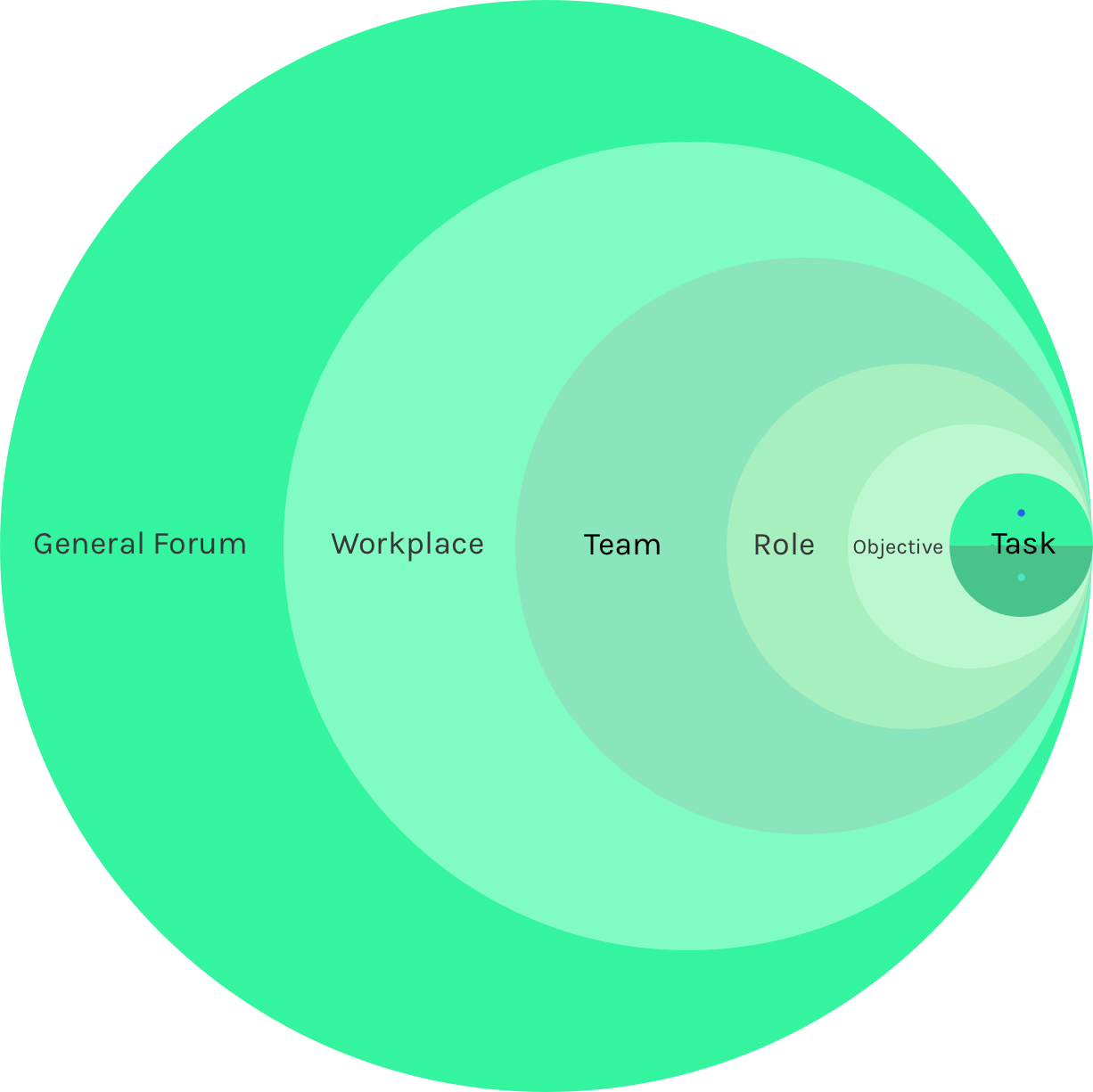
A Smartup is designed so that all ownership, work, and governance flow through six nested groups. Think of them as a set of Russian dolls: each group contains smaller subgroups, but all belong to the "mother" at the center, the General Forum.
-
1. General Forum
The heart of the Smartup All citizens (owners) gather here to discuss, propose, vote, and oversee everything. It's the public square for collective direction and accountability.
Members: All Smartup owners
Moderated by: Leadership Team -
2. Workplace
The production engine Citizens with a work license join to build what matters. Here, talk turns into action: plans become teams, teams build real things.
Members: All workers (colleagues)
Moderated by: Leadership Team -
3. Teams
Home base for specialized work Every worker joins at least one team—design, development, business. Teams focus effort and harness specific skills toward shared goals.
Members: Workers in same team (teammates)
Moderated by: Team Captain -
4. Roles
How you contribute In each team, workers apply for roles that fit their talents—UX designer, developer, communicator. Roles define responsibility and access.
Members: Workers with same role (peers)
Moderated by: Team Captain -
5. Objectives
What's to be achieved Teams progress by accomplishing specific missions, like "Create Android app front-end." Each objective unites multiple roles.
Members: Workers on same objective (squad)
Moderated by: Mission Leader -
6. Tasks
Where work happens The smallest—and most important—unit. Tasks create measurable progress. Complete task, create value, get rewarded.
Members: Assigned workers
Moderated by: Mission Leader
The Nested Structure
Each group lives within the one above it: General Forum contains → Workplace → Teams → Roles → Objectives → Tasks. This creates clear accountability chains while maintaining democratic oversight at the top.
The Metabolism - How a Smartup Lives and Breathes
What is this?
If the 6 Groups show a Smartup's anatomy (structure), the metabolism shows how it actually functions—how we communicate, make decisions, and get work done through the ADM Triangle system powered by the buddy system.
When we examine a Smartup as a living organism, we need to understand not just its structure, but how it sustains itself. Just as a body needs circulation and digestion, a Smartup needs processes for communication, decision-making, and documentation. This is where we discover the ADM Triangle—the metabolic engine that powers every interaction.
The Buddy System: Never Work Alone
At the core of our metabolism lies a simple but powerful principle borrowed from military operations: you never work alone. In a Smartup, every task, every decision, every action involves at least two people working in partnership.
Why Buddies Matter
The buddy system serves multiple vital functions:
- Accountability: Freedom with responsibility
- Support: Help when stuck or overwhelmed
- Quality: Built-in peer review
- Learning: Juniors learn by observing seniors
- Resilience: No single point of failure
The Learning Loop & The 90/10 Split
What makes our buddy system special is that it's designed as a learning mechanism:
When a task is completed, the Worker (Senior) receives 90% of the Smartup Credit (SC) budget. The Assistant (Junior) receives 10%. This isn't just payment for monitoring—it's an investment in developing the next generation of senior contributors.
graph LR
    J[Junior Role<br/><sub>Defender/Assistant</sub>]
    S[Senior Role<br/><sub>Attacker/Worker</sub>]
    T[Task Execution]
    L[Learning & Growth]

    S -->|Performs| T
    J -->|Observes & Assists| T
    T -->|Creates| L
    L -->|Promotes| J
    J -.->|Becomes| S
The ADM Triangle: Our Operating System
Building on the buddy system, every interaction in a Smartup follows the Attacker, Defender, Midfielder (ADM) pattern:
graph TD
    A[Attacker / Senior<br/><sub>Drives action forward</sub>]
    D[Defender / Junior<br/><sub>Learns while ensuring quality</sub>]
    M[Midfielder / Bot<br/><sub>Coordinates & documents</sub>]

    A <--> M
    D <--> M
    A -.->|Mentors| D
ADM in Action: Task Execution
Scenario: A senior developer takes on the task "Deploy emergency mesh network prototype"
- Senior Developer (Attacker): Implements solution, explains decisions
- Junior Developer (Defender): Assists, learns patterns, validates effort
- Bot (Midfielder): Logs activity, manages check-ins
The junior isn't just watching—they're actively learning deployment processes, understanding architectural decisions, and preparing to lead similar tasks in the future.
This Isn't About Control
Traditional organizations use monitoring for compliance and control. In a Smartup, the buddy system creates a learning environment where juniors gain real experience with safety nets, and seniors develop mentoring skills. The defender role isn't a watchdog—it's an apprenticeship.
The Freedom to Shift: Horizontal Career Development
What makes Smartup identity truly revolutionary is voluntary role shifting. Unlike traditional organizations where you're locked into your expertise, we embrace career fluidity.
Role Shifting in Practice
Marcus has been a senior backend developer for 5 years. He's excellent at it, but getting bored.
Traditional Organization: Marcus is stuck. His value is tied to his seniority in backend. Moving to UX means starting over, losing status and pay.
In a Smartup: Marcus can: * Continue taking senior backend tasks when he wants (90% as attacker) * Join the UX team as a junior member * Take on UX tasks as a defender (10%, learning from senior UX designers) * Gradually build UX skills while maintaining backend income
Result: Marcus expands his skillset, stays engaged, and the Smartup gains a developer who understands both backend AND user experience.
This fluid identity system creates what we call a learning economy:
graph LR
    SE[Senior Expert<br/><sub>Feeling Stagnant</sub>]
    JL[Junior Learner<br/><sub>in New Domain</sub>]
    ME[Multi-skilled Expert<br/><sub>Cross-functional</sub>]
    IV[Increased Value<br/><sub>To Individual & Smartup</sub>]

    SE -->|Chooses to Explore| JL
    JL -->|Learns Through Tasks| ME
    ME -->|Creates| IV
    IV -->|Enables More| SE
Identity Protocols: Who We Become in Each Space
What is this?
As we move between the 6 groups, we don't just change what we do—we change who we are. These identity protocols teach us how to show up in each space for maximum collective effectiveness.
The Six Identities We Embody
-
In the General Forum: We are CITIZENS --- Equal voice, equal vote, equal responsibility. The newest contributor has the same rights as the founding team. We debate, propose, and decide as equals.
-
In the Workplace: We are COLLEAGUES --- United by shared mission. We may have different skills and tasks, but we're all building toward the same vision. Collaboration over competition.
-
In Teams: We are TEAM MEMBERS --- Aligned on objectives. We coordinate our diverse skills toward specific goals, supporting each other's growth and success.
-
In Roles: We are PEERS --- Sharing expertise. Whether senior or junior, we're united by our craft, helping each other improve and solve technical challenges.
-
In Objectives: We are SQUAD MEMBERS --- Present and focused. We're here now, working on this specific mission, coordinating in real-time to achieve our goal.
-
In Tasks: We are ATTACKERS & DEFENDERS --- Executing with discipline. We take on specific roles—driving work forward or ensuring quality—with clear accountability.
Identity in Action: Sarah's Day
Sarah is a senior developer in Smartup Zero. Watch how she shifts:
9:00 AM - General Forum: As a CITIZEN, she votes on whether to pursue mesh networking, weighing in equally with designers and business developers. 9:30 AM - Workplace: As a COLLEAGUE, she reviews the overall ONLIFE roadmap, offering technical insights. 10:00 AM - Dev Team: As a TEAM MEMBER, she coordinates with other developers on the sprint plan. 10:30 AM - Backend Role: As a PEER, she mentors a junior backend developer struggling with protocols. 11:00 AM - Objective: As a SQUAD MEMBER, she syncs with frontend and QA on today's integration. 11:30 AM - Task #42: As an ATTACKER, she codes the mesh discovery feature while her junior DEFENDER reviews and learns.
Identity Discipline
These aren't just nice ideas—they're operational requirements. In our Matrix spaces, channels are named and moderated to reinforce these identities. Bringing "boss energy" to a peer space or "individual contributor" mindset to the General Forum disrupts our collective intelligence.
The Meta-Transparency Layer: ADM Between Groups
What is this?
The ADM Triangle doesn't just operate within groups—it creates a transparency cascade from the outside world all the way down to individual tasks, ensuring accountability and alignment at every level.
We've seen how the ADM Triangle works within each group. But the true power emerges when we see how it connects the groups themselves, creating what we call the meta-transparency layer—a complete chain of accountability from public oversight to task execution.
The Oversight Cascade
Each group in our 6-layer structure maintains oversight of the group below it through its own ADM Triangle:
-
0_timeline → General Forum
A: Citizens taking initiative with proposals/votes
D: Leadership team ensuring quality moderation
M: Bot documents everything to 0_timeline
The outside world sees our governance in action -
General Forum → Workplace
A: Colleagues taking initiative with work
D: Leadership team ensuring OSBP compliance
M: Bot reports progress to General Forum
Citizens oversee how work gets done -
Workplace → Teams
A: Team members taking initiative in teams
D: Team captains ensuring strategy/budgets
M: Bot reports team health to Workplace
Colleagues oversee team formation -
Teams → Roles
A: Peers taking initiative in skill areas
D: Team captain ensuring roles are filled
M: Bot reports role coverage to Teams
Teams oversee skill distribution -
Roles → Objectives
A: Squad members taking initiative on missions
D: Mission leaders ensuring coordination
M: Bot reports objective progress to Roles
Peers oversee objective participation -
Objectives → Tasks
A: Worker taking initiative to complete
D: Assistant ensuring quality/learning
M: Bot reports task status to Objectives
Squads oversee task execution
A Complete 12-Day Flow Example
Let's follow a decision from inception to execution:
- Day 1 - Citizen Initiative: In the General Forum, citizens (A) propose adding mesh networking. Leadership team (D) facilitates. Bot (M) publishes proposal to 0_timeline.
- Day 3 - Vote Passes: Colleagues in Workplace (A) volunteer to implement. Leadership team (D) ensures it fits OSBP. Bot (M) reports commitment to General Forum.
- Day 5 - Team Forms: Dev team members (A) organize. Team captain (D) allocates budget. Bot (M) reports team formation to Workplace.
- Day 7 - Roles Activate: Backend peers (A) define skills needed. Team captain (D) ensures roles are staffed. Bot (M) reports skill gaps to Teams.
- Day 10 - Objective Launches: Squad members (A) begin "Build Mesh Prototype". Mission leader (D) coordinates. Bot (M) reports progress to Roles.
- Day 12 - Tasks Execute: Senior dev (A) codes feature. Junior dev (D) assists and learns. Bot (M) logs 4 hours work, reports completion to Objective.
Result: Complete transparency from public proposal to code commit. Every stakeholder can trace the path.
The Official Smartup Business Plan (OSBP)
What is this?
The OSBP is the living, breathing constitution of a Smartup—where an entrepreneur's vision transforms into collective property through democratic participation and continuous evolution.
From "My Idea" to "Our Mission"
Every Smartup begins with an entrepreneur who sees a solution to an SDG challenge. But unlike traditional startups where founders retain control, the OSBP is the mechanism for transferring ownership to the collective.
flowchart LR
    E[Entrepreneur<br/>Vision v0.1] --> C[Community<br/>Validation]
    C --> T[Teams Add<br/>Assessments]
    T --> V1[OSBP v1.0<br/>Design Phase]
    V1 --> V2[OSBP v2.0<br/>Production]
    V2 --> V3[OSBP v3.0<br/>Organization]
    V3 --> V4[OSBP v4.0<br/>Market Ready]

    style E fill:#ff6b6b,stroke:#333,stroke-width:2px,color:#000
    style V4 fill:#8bc34a,stroke:#333,stroke-width:2px,color:#000
The Three Groundings
Every OSBP must establish legitimacy through three essential groundings:
- SDG Grounding: Which SDGs does this address? Why is this problem critical? How does our solution help? What's the measurable impact?
- Scientific Grounding: Evidence the solution works. Research backing approach. Technical feasibility studies. Peer-reviewed references.
- Democratic Grounding: The reality check: "Do enough people want this?" Proven through crowdfunding success, team formation, and active owner recruitment.
The Democratic Test: From 'I Think' to 'We Know'
"I think this is a good idea and I've done my homework. Now let's find out if enough other people agree and want this as badly as I do. Not through surveys or likes, but through real commitment—joining as owners, contributing funds, volunteering skills. If we can't rally enough people in validation, we shouldn't build it."
OSBP Structure and Living Evolution
The OSBP sections map directly to team responsibilities:
| Section | Responsible Team | Core Questions |
|---|---|---|
| 1. Executive Summary | Leadership Team | Why does the world need this? What's our vision? |
| 2. Design Blueprint | Design Team | How will it work from user perspective? |
| 3. Development Blueprint | Development Team | How do we build it? What's been built? |
| 4. Business & Marketing | Business Team | How does it sustain itself? Validation budget? |
| 5. Media & Message | Media Team | How do we communicate? What's our voice? |
| 6. R&D Roadmap | Science Team | What research questions must we answer? |
| 7. Definition of Ready | Operational Team | When are we ready for Design Phase? |
The Living Document Process: The OSBP isn't what we pitch to investors—it is living documentation of our evolving reality. Updates follow a strict Lazy Consensus period (72 hours in Workplace), followed by a 48-hour General Forum notification, before being auto-published to timeline0.org.
Progressive Transparency Architecture
The Information Democracy
This section defines how Smartup Zero balances radical transparency with strategic protection through a three-tier access system. Unlike traditional organizations that operate on extremes (total secrecy vs. naive openness), Smartups pioneer Progressive Transparency—where access to information is earned through demonstrated commitment, while governance remains democratically open to all.
The Smartup Innovation: Process transparency + Strategic discretion. How we work is visible, what we build is revealed progressively.
The Three-Tier Information System
-
Tier 1: Universal Access (
1_general_forum)- Access: Open to the entire world
- Contents: Complete OSBP, Book of Owners, currency ledger (SC/SK), voting outcomes.
- Philosophy: "Democracy requires transparency. Every citizen should see how decisions are made."
-
Tier 2: Licensed Contributor Access (
2_workplaceand below)- Access: Work & Campaign License holders
- Contents: Implementation code, active development workflows, work-in-progress features.
- Philosophy: "Our collective work deserves protection from free-riders."
-
Tier 3: Organizational Governance
- Access: Team Captains and Founder/Group License holders
- Contents: Cross-team coordination, sensitive partnership negotiations, legal documentation.
- Philosophy: "Strategic coordination without compromising democratic principles."
The 5 License Progression: Earning Trust
| License Level | Access Tier | Purpose | Key Rights |
|---|---|---|---|
| Watch | Tier 1 + limited 2 | Serious evaluation | Read-only internal docs, community calls. 1 Vote. |
| Campaign | Tier 1 + Comms | Amplify story | Complete narrative tasks, earn SK. 1 Vote. |
| Work | Full Tier 2 | Direct contribution | Claim tasks, earn SC, access dev resources. 1 Vote. |
| Group | All Tiers | Collective citizen | NGO/Org delegates workers, retains strictly 1 Vote. |
| Founder | All Tiers | Stewardship | Approved via SC funding or SK threshold. 1 Vote. |
The Weekly Sync: Internal Innovation, External Accountability
Every team operates a dual blueprint system with democratic oversight. Internal blueprints (code, live progress, failed attempts) are synced to External blueprints (progress summaries, resource needs) every Friday.
graph LR
    A[Friday: Team Captains Submit] --> B[48h Community Review]
    B --> C{Sunday 10pm Decision}
    C -->|≤3 Issues| D[Auto-merge & Publish]
    C -->|>3 Issues or Veto| E[Postpone Publication]
    D --> F[timeline0.org Updates]

    style D fill:#8bc34a,stroke:#333,stroke-width:2px,color:#000
    style E fill:#e74c3c,stroke:#333,stroke-width:2px,color:#000
Democratic Safeguards: The sync process relies on Lazy Consensus, but Leadership maintains a veto, and more than 3 unresolved community issues will postpone publication.
This architecture embodies the core Smartup principle: Technology should serve collective human needs, built by and for the communities that use it, with full democratic accountability but protection from extraction.
The result is an organization that is both radically transparent in its governance and strategically intelligent in its operations—capable of competing with traditional startups while remaining true to collective ownership principles.
Ready to Contribute?
Join the Project
Become a Smartup Zero owner
Reach out
Contact the 3_1_leadership_team with questions or remarks